

Microsoft announces Windows Sandbox, a virtualized safe space for testing untrusted apps - johnsonextralas
Windows Sandbox is hither to protect your PC. A simple, virtualized Windows within Windows, IT's a place where an app can make up safely run if you're worried it might be malware.
Microsoft announced Windows Sandbox Tuesday evening in a blog post, unearthed by ZDNet. Microsoft pre-declared that Windows Sandbox would first be tested within a later Windows 10 Insider physique, beginning with frame 18305 operating room newer. (At press time, Windows Insider build 18298 was the latest public free.) You'll need a 64-bit processor with virtualization enabled in the BIOS and within Windows, and either Windows 10 Host or Windows 10 Pro. Windows 10 Home users South Korean won't be able to use Windows Sandpile.
Sandbox is a "isolated, temporary, background environment where you can run untrusted software without the venerate of lasting impact to your Microcomputer," Hari Pulapaka, the group heart and soul manager for the Windows kernel, desribed. "Whatever software installed in Windows Sandpile corset single in the sandpile and cannot sham your host. In one case Windows Sandpile is closed, all the software with whol its files and state are permanently deleted."
Windows 10 Pro and Host pot already make over a virtual political machine on your Microcomputer, which creates an replicate of Windows that's isolated from the host. Each time Windows Sandbox runs, Pulapaka said, information technology creates a "pure" simulate of Windows for testing. Unless the malware prat somehow break out of that virtualized environment, Windows 10 Hyper-V (and Sandpile) should be able to create secure environments for testing.
 Microsoft
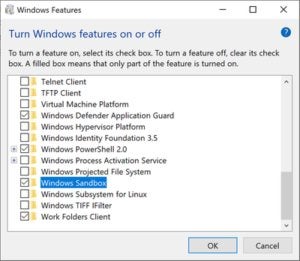
 You'll need to enable Sandbox first, before you begin using it.
Like Hyper-V, Windows Sandbox will non automatically be enabled. You'll need to type "Windows Features" in the Seek box and check the Sandbox box. Your Microcomputer will likely re-start. Testing an app bequeath then be arsenic easy every bit running Sandbox and copying the app into the virtual environment.
Pulapaka renowned that an app running in Sandpile will run in a somewhat lower-execution mode, because information technology's using only part of the resources of your PC. (You'll take at least 4GB of Random-access memory, with 8GB recommended, 1GB of disk space, and at least 2 free C.P.U. cores.) Microsoft engineered some tricks to slenderize the VM's sizing: It's just 100 MB when actually running. And although the initial boot time volition take some time, Microsoft wish freeze the state of the VM, post-boot, and refer to it when opening approaching instances of Sandbox—reduction that boot time significantly. Sandbox will likewise cost healthy to virtualize some of the PC's graphics resources.
"The whole destination here is to treat the Sandbox like an app but with the protection guarantees of a Virtual Automobile," Pulapaka wrote.
What this agency to you: Virtualization is a key component of portion covert apps and websites that you may not trust: Windows Device Application Guard, for representative, is a little-known secure browser inside your Microcomputer for browsing untrusted sites. You Crataegus oxycantha never demand to exercise Windows Sandpile, but the idea is that it's a safety net, and a tool to use if you're just not that sure just about whether an app is truly safe.

Source: https://www.pcworld.com/article/403059/microsoft-announces-windows-sandbox-a-virtualized-safe-space-for-testing-untrusted-apps.html
Posted by: johnsonextralas.blogspot.com
0 Response to "Microsoft announces Windows Sandbox, a virtualized safe space for testing untrusted apps - johnsonextralas"
Post a Comment